

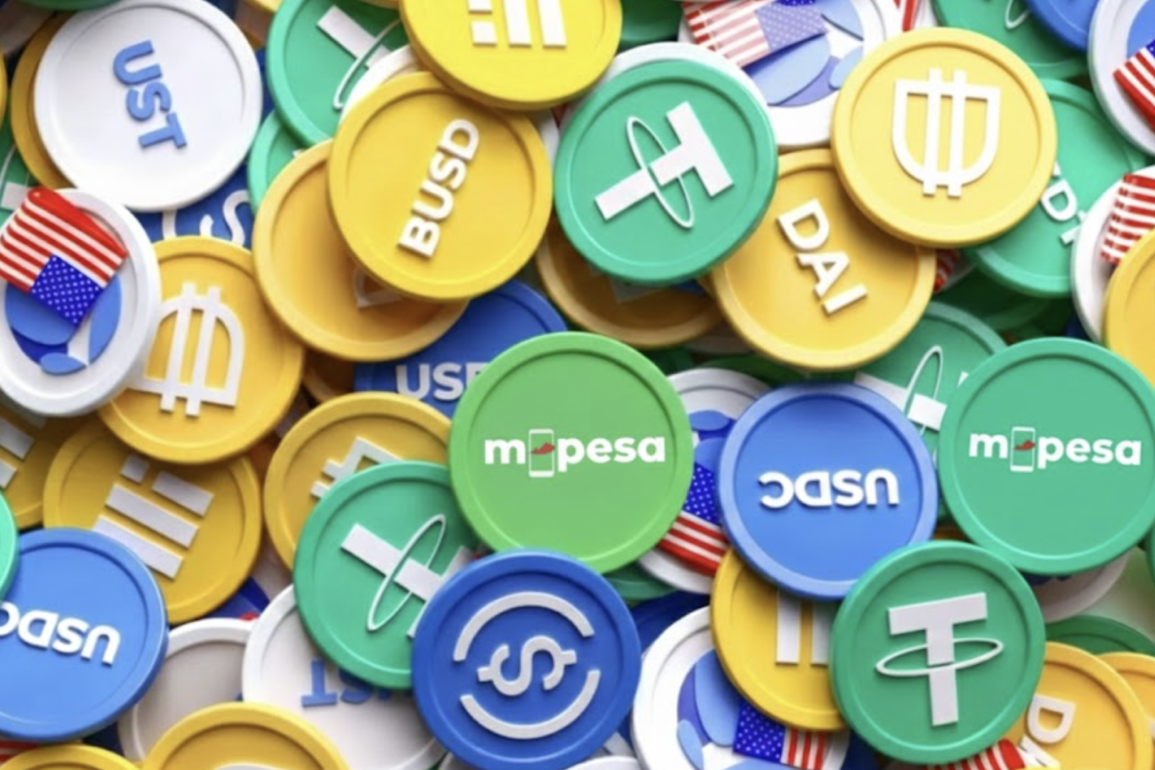
The transaction takes eleven minutes from start to finish. Grace Wambui sends an invoice to Berlin at 9:47 a.m. By 9:52, USDC stablecoins hit her phone. At 9:58, she converts them to Kenyan shillings. No bank. No wire transfer. No Western Union. Just her phone, a few taps, and M-Pesa, the mobile money platform that already processes more transactions annually than the entire GDP of most African nations.
This is not experimental fintech anymore. It is how 6.1 million Kenyans now move money. And it is about to become infrastructure.
M-Pesa, which revolutionized banking for the unbanked nearly two decades ago, announced last month it is partnering with Abu Dhabi’s ADI Foundation to plug blockchain rails directly into its 66.2 million user network across eight African countries. What has been happening in the streets and matatus and corner shops of Nairobi is about to scale.
From Mobile Money to Digital Dollars
Kenya processed approximately $3.3 billion in stablecoin transactions in the 12 months ending June 2024, according to blockchain analytics firm Chainalysis, making it the fourth-largest recipient of stablecoins in Africa behind Nigeria, South Africa, and Ghana.
The global stablecoin market is a rapidly growing segment of digital finance, with a market capitalization of over $300 billion as of September 2025, and daily transaction volumes around $100 billion. The market is dominated by a few key players and is increasingly influenced by global regulatory developments.
More remarkably, Kenya now ranks fifth globally for stablecoin transactional use, outpacing major economies like the United Kingdom, India, and Indonesia.
These aren’t speculative trades. Kenyans are using stablecoins—cryptocurrencies pegged 1:1 to traditional currencies like the U.S. dollar—for everyday financial needs: remittances from the diaspora, cross-border trade settlements, freelancer payments, and as a hedge against currency volatility.
“When it started, the driver was remittances, where people living in the diaspora were sending money home,” explains Peter Mwangi, country manager of Yellow Card, Africa’s leading stablecoin infrastructure provider. “The reason they used stablecoins was that transaction fees were minimal, while it was also permissionless finance.”
The cost advantage is stark. Stablecoin transfers average between 0.5 and 1 percent of the value sent, compared to 4-7 percent for traditional remittance channels like Western Union or bank transfers, according to Yellow Card. For a $200 remittance—typical for many diaspora families—that difference can mean the difference between paying rent on time or falling behind.
But the use case has evolved. “Businesses are now adopting stablecoins,” Mwangi says. “For instance, an exporter of tea or Maasai shukas to the US would prefer receiving payments in stablecoins as that transaction can only take five minutes at most and converting that to Kenya shillings is much easier and cheaper.”
The M-Pesa Advantage
Kenya’s stablecoin surge didn’t happen in a vacuum. It’s built on the foundation of M-Pesa, the mobile money platform that revolutionized financial inclusion when it launched in 2007. M-Pesa now has over 60 million active users and processed more than $450 billion in transaction volume in 2025, making it the world’s most developed mobile payment system.
“Kenya’s strong mobile money ecosystem, especially M-Pesa, allows for seamless stablecoin integration,” notes Mwangi. “A tech-savvy youth population is also turning to stablecoins for cheaper remittances and protection against currency swings, making them practical financial tools.”
The infrastructure is already in place. Companies like Yellow Card, Kotani Pay, and more recently, Payd, have built bridges between blockchain networks and mobile money wallets, allowing users to convert stablecoins to M-Pesa-accessible shillings almost instantly. Stablecoins accounted for 43 percent of all crypto transactions in sub-Saharan Africa in 2024.
Even multinationals have taken notice. Starlink, Elon Musk’s satellite internet service, converts payments collected in Kenyan shillings into stablecoins and transfers them to America, where they’re exchanged into dollars, according to reports.
Enter the Blockchain
The ADI Foundation partnership announced in January 2026 aims to take this grassroots movement institutional. Backed by Sirius International Holding, the digital arm of a $240 billion UAE conglomerate, ADI Chain is the Middle East and North Africa region’s first institutional Layer 2 blockchain network designed specifically for stablecoins and tokenized real-world assets.
“We are excited to partner with ADI Foundation to tap into their expertise around new technologies and how these can transform financial services,” said Sitoyo Lopokoiyit, CEO of M-Pesa Africa, a joint venture between Safaricom and Vodacom.
The partnership will extend blockchain infrastructure to M-Pesa’s user base across Kenya, the Democratic Republic of Congo, Egypt, Ethiopia, Ghana, Lesotho, Mozambique, and Tanzania. A stablecoin for use on ADI Chain is expected to launch in January 2026, according to Huy Nguyen Trieu, council member on the ADI Foundation’s board of advisers.
“M-Pesa has been amazing in terms of financial inclusion,” Nguyen Trieu says. “Our view is that we can push it further again by providing the right digital infrastructure, both for individuals and SMEs. The foundation’s infrastructure can act as the building blocks to accelerate digital transformation.”
ADI Chain comes with heavyweight institutional backing. In December 2025, the foundation announced partnerships with BlackRock, Mastercard, and Franklin Templeton, signaling serious institutional appetite for regulated blockchain infrastructure in emerging markets.
Regulation Catches Up
For years, Kenya’s cryptocurrency ecosystem operated in a regulatory gray zone—not quite legal, not quite illegal. That changed dramatically in November 2025 when the Virtual Asset Service Providers (VASP) Act took effect, establishing Africa’s most comprehensive framework for cryptocurrency regulation.
The law, gazetted on October 21, 2025, designates the Central Bank of Kenya and the Capital Markets Authority as joint regulators of digital assets, with the Central Bank overseeing stablecoin issuers, wallet providers, and payment processors, while the Capital Markets Authority licenses exchanges and trading platforms.
“The Act provides the legislative framework for regulating and supervising Virtual Asset Service Providers,” the regulators said in a joint statement. “The Act further outlines obligations of VASPs in the prevention of Money Laundering, Terrorism Financing, and Proliferation Financing.”
While no licenses have been issued yet—regulations are still being drafted—the framework signals a fundamental shift in Kenya’s approach to cryptocurrency. Rather than prohibition or skepticism, Kenya is embracing regulation designed to enable innovation while protecting consumers.
“We are on the right footing because we now have a proper framework and foundation allowing for the regulation of most of the industry,” says Yellow Card’s Mwangi. “It also shows that regulators are more open to learning more about virtual assets.”
The timing is strategic. Kenya remains under scrutiny from the Financial Action Task Force (FATF), the global money laundering watchdog, and faces pressure to modernize its financial system. The VASP Act helps Kenya meet international anti-money laundering standards while positioning the country as a potential regional hub for digital finance.
Real Test
The evidence that stablecoins can transform lives isn’t theoretical. A pilot program by Mercy Corps Ventures tested $5 micropayments from abroad to Kenyan freelancers. Using stablecoins reduced transaction fees from 29 percent to 2 percent, according to the Milken Institute. Users saved more money and accessed their earnings faster—even without a bank account.
That kind of impact matters in a region where the World Bank reports Sub-Saharan Africa received $54 billion in remittances in 2023, yet sending money to the region remains the costliest globally, averaging 7.9 percent in fees for a $200 transfer.
“For millions navigating inflation, currency controls and the world’s priciest remittance corridors, stablecoins offer a way to hold value and move money with little more than a phone,” notes a Cointelegraph analysis of African stablecoin adoption.
The use cases extend far beyond remittances. In November 2025, Prime Cabinet Secretary Musalia Mudavadi reported that over Ksh1 trillion had been sent home by Kenya’s diaspora—and an increasing share of that flows through stablecoin rails.

Questions
The rush to embrace stablecoins raises important questions about financial stability, consumer protection, and monetary sovereignty. Kenya’s inflation stood at 4.5 percent in August 2025, relatively modest by regional standards but enough to drive demand for dollar-denominated assets among traders and savers.
The widespread adoption of dollar-pegged stablecoins could effectively dollarize parts of the economy, potentially undermining the Central Bank’s monetary policy tools. “If we were to see a Kenya shilling backed stablecoin, this would spur tokenisation in the economy,” Mwangi suggests. “Fintech companies would emerge, tokenising stocks in the Nairobi Securities Exchange (NSE) while the government could itself tokenise its bonds expanding the pool of investors participating in auctions.”
Infrastructure challenges persist. A Milken Institute report notes that broadband access remains limited in rural areas, and financial education gaps could leave vulnerable populations exposed to scams and volatility risks.
“Stablecoins are only as reliable as the reserves and governance behind them,” warns a CoinTelegraph analysis. The collapse of Terra’s UST stablecoin in 2022, which wiped out billions in value, remains a cautionary tale.
Regulatory complexity looms large. The VASP Act’s dual-licensing structure—requiring compliance with both virtual asset and gambling laws for crypto betting platforms, for example—could create prohibitive barriers for smaller players and startups, potentially favoring large international operators over local innovation.
Silicon Savannah Meets Web3
Despite the challenges, Kenya’s trajectory seems clear. The country is evolving from a mobile money pioneer to what industry observers call a “crypto-compatible finance hub.” The EY report cited by Semafor spotlights Nairobi, dubbed “Silicon Savannah,” as a successful example of a thriving ecosystem to drive financial inclusion, benefiting from Kenya’s regulatory innovation and position as one of East Africa’s most mature fintech landscapes.
The numbers support this narrative. According to Chainalysis, stablecoins now account for roughly 43 percent of all crypto transaction volume in Sub-Saharan Africa, reflecting their growing use for remittances, cross-border trade, and savings.
For Kenya’s growing class of digital workers—freelancers, developers, designers, and remote workers serving global clients—stablecoins have become essential infrastructure. Startups like Payd are building “financial operating systems for borderless work,” using stablecoin settlement rails while abstracting away the complexity for end users who simply see money arriving in their accounts.
“Most users never interact with wallets, chains, or tokens directly—they simply receive and use money as they would in their bank account,” says Benaiah Wepundi, co-founder of Payd.
As the M-Pesa-ADI partnership moves from memorandum of understanding to implementation in 2026, Kenya stands at a crossroads. The country that pioneered mobile money for the unbanked now has an opportunity to pioneer blockchain-based financial services for the underserved.
The IMF says stablecoin issuance has grown to $300 billion in 2025, but warns that increased adoption poses financial risks if left unchecked. Kenya’s regulatory framework, if implemented effectively, could serve as a model for other emerging markets seeking to harness crypto innovation while protecting consumers.
“Stablecoins will also be adopted by some of our biggest financial players in our markets here in Kenya, including banks and mobile network operators,” predicts Mwangi.
The stakes are high. With 42 percent of adults in sub-Saharan Africa remaining unbanked, traditional financial systems have left hundreds of millions without access. Yet demand for digital financial solutions is undeniable. Africans have embraced crypto to hedge against currency volatility, with stablecoins particularly attractive due to their dollar peg.
For Grace Wambui, the graphic designer in Kilimani, the promise of faster payments, lower fees, and the ability to compete in the global digital economy can no longer be handicapped by her location. Whether that promise extends to tens of millions more across Africa may depend on how successfully regulators, traditional financial institutions, and blockchain innovators navigate the challenges ahead.