



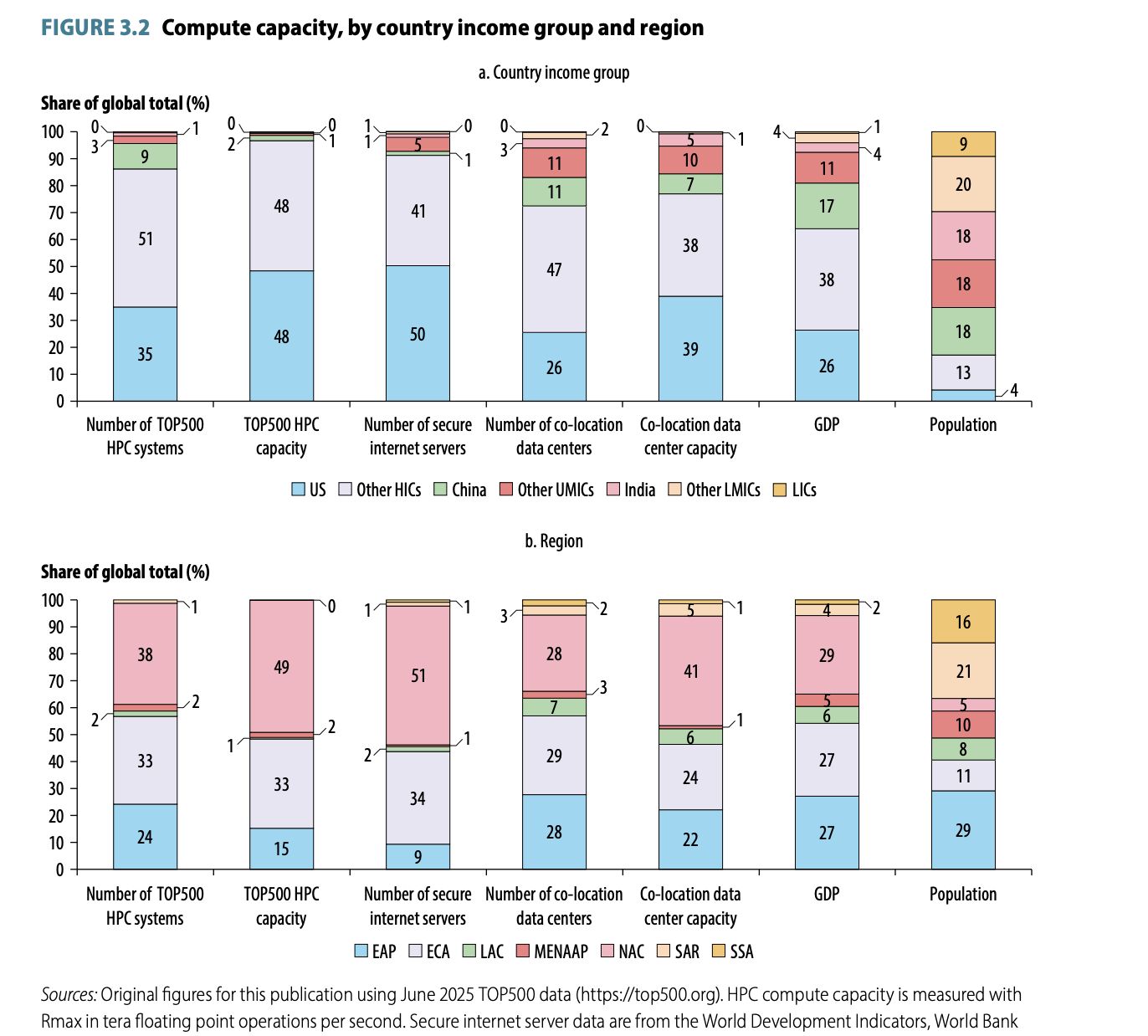
As artificial intelligence sweeps across economies and governments alike, a quieter crisis is unfolding beneath the excitement: the world’s capacity to compute, the raw processing power needed to train and run modern AI, is becoming its own form of inequality.
The Digital Progress and Trends Report 2025 released recently by the World Bank warns that countries without access to high-performance computing (HPC) risk being locked out of the next wave of economic growth, scientific discovery and digital public services. And despite the promise of AI to close gaps between rich and poor nations, the report finds that the “compute barrier” is instead widening them.
Across the world, governments are grappling with the same question: who gets to innovate in an era where compute is scarce, expensive, and controlled by a handful of global technology firms?
Wealthier nations race ahead
“Countries at the forefront of AI development need to secure adequate computing resources to maintain their competitive advantage, foster continued innovation, safeguard national security, and drive economic growth,” the report says.
The United Kingdom, it notes, has already announced £300 million for two national supercomputers to accelerate AI research. India, unable to match the spending power of Western tech economies, has instead turned to partnerships. The government is collaborating with NVIDIA to build the NVIDIA AI Technology Center and is planning to offer affordable GPUs to startups and universities, a model the report highlights as a creative workaround.
Such public-private partnerships, or PPPs, can help “provide AI start-ups and researchers with access to compute resources, accelerating innovation.” But the World Bank is blunt about their limits: “these programs are costly to scale and maintain over time,” and ultimately shift the financial burden to taxpayers.
Even when they work, they don’t solve the underlying problem. “These measures do not directly tackle the underlying issue of scarcity,” the report warns. “Subsidies and PPPs are only short-term strategies rather than long-term solutions to the compute scarcity problem.”
Rising fears over Big Tech dominance
The World Bank also points to a fragile competitive landscape, where cloud providers and AI model developers are often the same companies. “Big tech companies are aggressively pursuing investments and alliances with AI start-ups through their cloud computing arms,” it notes, raising concerns that firms that control compute may also shape, or restrict who can build the next generation of models.
“AI start-ups that need to train models have little choice but to rush into the arms of large companies offering essential cloud computing,” the report states.
Regulators have begun to react. The U.S. Federal Trade Commission’s 2022 move blocking NVIDIA’s acquisition of Arm is cited as an example of “stimulating innovation.” Competition agencies in the U.K., France, Japan, Korea and the Netherlands are also investigating cloud market concentration.
“It is critical for regulators to monitor competition dynamics… and ensure market contestability and nondiscrimination,” the report says.
Small countries turn to each other
For nations too small to attract major data-center investment such as Burundi, the report recommends strategies that might have sounded far-fetched a decade ago: data embassies, shared regional data centers, and cooperative cloud platforms.
“Small nations can achieve economies of scale and risk diversification by collaborating on shared regional data center facilities,” the report notes.
Estonia pioneered the “data embassy” concept in 2017 when it placed secure servers in Luxembourg. Monaco followed in 2021. Australia is now exploring a version that would allow Pacific nations to store critical data offshore without surrendering sovereignty.
“As the AI era accelerates, developing countries need to be prepared to leap forward. Small AI offers a unique opportunity to bypass traditional development barriers and spark homegrown innovation and inclusive growth,” says Axel van Trotsenburg, former Senior Managing Director at World Bank.
But even the most innovative solutions come with complications. “Challenges with diplomacy, data sovereignty, geopolitics, and equitable cost sharing must be navigated,” the report warns. Deep trust and complex agreements are required.
The talent gap nobody talks about
Money and hardware matter. But according to the World Bank, a quieter barrier is emerging: a global shortage of people who know how to use cloud and AI systems at scale.

“Cloud credits frequently go underused in developing countries,” the report says, because organizations lack the architects, security professionals and data engineers who know how to deploy and manage AI workloads. Training is not keeping pace with ambition.
To fix this, the report says “Governments can help close this gap by integrating cloud skills into national digital skills strategies, supporting specialized training for ICT professionals, and creating hands-on learning opportunities in partnership with cloud providers.”
Without that talent base, even free cloud access remains theoretical.
Countries falling furthest behind
For countries without even basic digital foundations, the path is steep. The report urges a first focus on connectivity: “prioritizing investment in high-speed broadband access for households and businesses is crucial.”
Undersea cables now ring much of Africa, but “a dearth of onshore lines to carry data inland leaves much of that internet capacity wasted,” the report says, is a bottleneck without which the AI revolution cannot reach schools, clinics or small businesses.
The World Bank stops short of offering a single blueprint, but it is clear about one point: compute scarcity is becoming a structural challenge as fundamental as electricity or clean water, a determining factor in whether countries can compete in a global economy increasingly defined by AI.
“Although the paths vary depending on existing capabilities, a proactive, collaborative multistakeholder approach… is critical for countries to ensure sufficient compute resources while mitigating risks and negative effects,” the report concludes.
The computing power that enables large language models and autonomous systems is no longer just the domain of private laboratories. It is shaping geopolitics, reshaping economies, and rewriting the relationship between governments and their citizens.
The real question, the report implies, is not simply who builds the fastest chips, but who gets left behind when the world runs on them.